
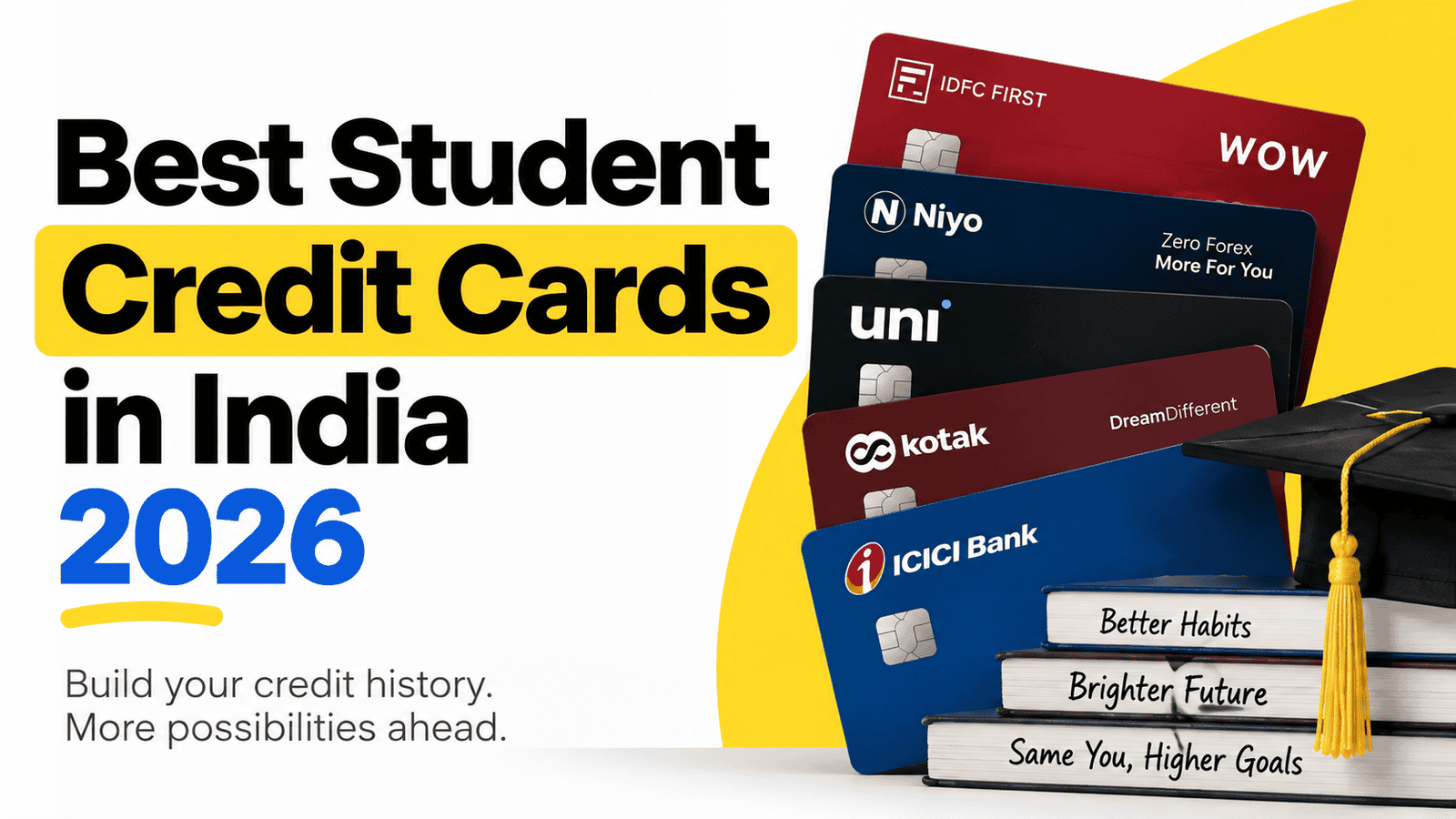
Getting your first credit card as a student can be surprisingly difficult. Most students do not have a regular income, salary slips, ITRs or an established credit history, which makes traditional credit cards harder to get. This is where FD-backed credit cards become useful. You place a Fixed Deposit with the bank and receive a credit card against it, allowing you to start building your credit history without needing a high income or an existing CIBIL score. But not every FD-backed card is equally useful for students. Here are the best student-friendly credit cards in India right now, based on factors such as FD requirement, fees, rewards, international usage and overall value.
Best Student Credit Cards in India
1. IDFC FIRST WOW Credit Card
The IDFC FIRST WOW Credit Card is one of the strongest options for students who want their first credit card without income proof or an existing credit history. IDFC FIRST Bank specifically positions the card for students and states that applicants can get the card without income proof or a credit history, with eligibility starting at 18 years of age. The current minimum Fixed Deposit requirement is ₹20,000, and the credit limit can be up to 100% of the FD value.
The card has no joining fee and no annual fee, making it a lifetime-free option. The FD continues to earn interest, with the bank currently listing interest of up to 6.5% on the FD. Another major advantage is zero forex markup, which makes the card particularly useful for students who pay for international subscriptions, shop on foreign websites or travel abroad. The card also offers up to 4X reward points on eligible spending.
For a student looking for an all-round first credit card, the combination of no income proof, no credit history requirement, zero annual fee, zero forex markup and an FD-linked credit limit makes IDFC FIRST WOW a very compelling choice. The only major hurdle is the ₹20,000 minimum FD, which may not be comfortable for every student.
2. Niyo Secured Credit Card
The Niyo Secured Credit Card is another interesting option for students, particularly those who expect to make international payments or travel abroad. Its biggest attraction is its zero-forex proposition, making it more useful than a typical entry-level card when foreign currency transactions are involved. The card is issued against an FD, so students without a regular income or established credit history can use the secured-card route to start building their credit profile.
Niyo’s appeal is not limited to international transactions. It is also designed as a beginner-friendly secured credit card, with a relatively low entry barrier compared with cards that require a much larger FD.
For students who want a first card primarily for everyday spending and credit building, IDFC FIRST WOW may offer a more balanced package. However, if international spending is an important part of your use case, Niyo becomes considerably more attractive.
3. AU NOMO Credit Card
The AU NOMO Credit Card is another option for students who want to start building their credit history through a secured credit card. Since the card is linked to a Fixed Deposit, it can be suitable for applicants who do not have a regular income or an established credit history.
The card has a relatively low entry barrier compared with many traditional credit cards. The FD-backed structure allows students to start using a credit card while keeping the focus on responsible spending and timely repayments rather than an established credit profile.
AU NOMO currently has a one-time joining fee of ₹199. There is no separate annual renewal fee listed for the card. The card also earns reward points on eligible spending, with the bank’s current terms listing a monthly reward-point cap of 5,000 points for NOMO.
For students, the biggest advantage of AU NOMO is its role as a starter secured credit card. It can be useful for someone who wants to begin building a credit history while keeping the initial FD requirement manageable.
However, if you want the strongest overall combination of zero annual fee, zero forex markup and rewards, IDFC FIRST WOW remains a more compelling option. AU NOMO is better viewed as an additional secured-card option rather than the top choice for most students.
4. Kotak 811 DreamDifferent Credit Card
The Kotak 811 DreamDifferent Credit Card is a secured credit card designed for people who want to start or rebuild their credit history. It does not require income proof or a CIBIL score, and the minimum FD requirement is ₹10,000. The credit limit can be up to 90% of the FD value.
The card currently offers 2% cashback on eligible transactions, including eligible UPI transactions. However, there is an important condition: you need to spend at least ₹15,000 in a billing cycle to become eligible for cashback, with the total cashback capped at ₹500 per billing cycle and UPI cashback capped at ₹200. UPI cashback is applicable when transactions are made through the Kotak 811 app.
The card has no annual fee, although the current joining fee is ₹500 including GST from September 1, 2026. The FD continues to earn interest while it remains linked to the card.
For students who regularly spend ₹15,000 or more in a billing cycle, the cashback can make this card interesting. But if your monthly spending is much lower, the cashback condition makes the card considerably less attractive.
5. ICICI Bank Instant Platinum Credit Card
The ICICI Bank Instant Platinum Credit Card is another option for students who want to enter the credit-card ecosystem through an FD-backed card. The biggest advantage here is the ICICI Bank ecosystem, which can be useful if you already have an ICICI relationship or prefer keeping your banking and credit products with the same institution.
However, this card requires a significantly higher FD compared with some of the other student-friendly options. That makes it less attractive for students who simply want a first credit card to build their credit history without locking away a large amount of money.
If you already have an ICICI Bank relationship and are comfortable with the FD requirement, the card can make sense. But for most students starting from scratch, lower-FD options provide a more practical entry point.
Conclusion
A student credit card should not be chosen simply because it offers the highest cashback or the biggest list of rewards. The more important factors are the amount of FD you need to maintain, annual and joining fees, the credit limit you receive, international transaction charges and how easily you can use the card to build a responsible credit history.
For most students, an FD-backed card is the most practical way to get started because it reduces the importance of income and existing credit history. Among the options discussed here, IDFC FIRST WOW stands out as the strongest overall package, particularly because of its zero annual fee, zero forex markup, no income-proof requirement and 100% FD-based credit limit.
If international spending is your priority, Niyo is worth considering. If cashback is more important and your monthly spending is high enough to meet the eligibility threshold, Kotak 811 DreamDifferent can be interesting. The right choice ultimately depends on how much FD you are comfortable keeping and how you plan to use the card.
Most importantly, remember that a credit card is not extra income. Use it for manageable expenses and pay the full bill on time every month. For a student, the biggest long-term benefit of a first credit card may not be the cashback at all. It may simply be the opportunity to start building a strong credit history before entering the next stage of your financial life.

I write about credit cards, personal finance, banking products, and money-saving tips for CardZen. My aim is to make financial topics easier to understand and help readers make informed decisions.