
Getting a credit card can be difficult if you do not have a regular income, have no credit history, or have faced repeated rejections from traditional credit card issuers.
This is where FD-backed credit cards can be useful.
Instead of relying primarily on your income and credit history, these cards are secured against a Fixed Deposit. You create an FD with the issuer or its partner bank, and the FD acts as security for the credit card.
The good news is that you do not always need a large FD to get started. Some secured credit cards in India are available with deposits of just ₹1,000 or ₹2,000, while the Utkarsh SuperCard currently allows applications starting with a ₹100 deposit.
However, the lowest FD requirement does not automatically make a card the right choice. You also need to consider the credit limit, annual fee, cashback, UPI support, and whether the card’s benefits actually match your spending habits.
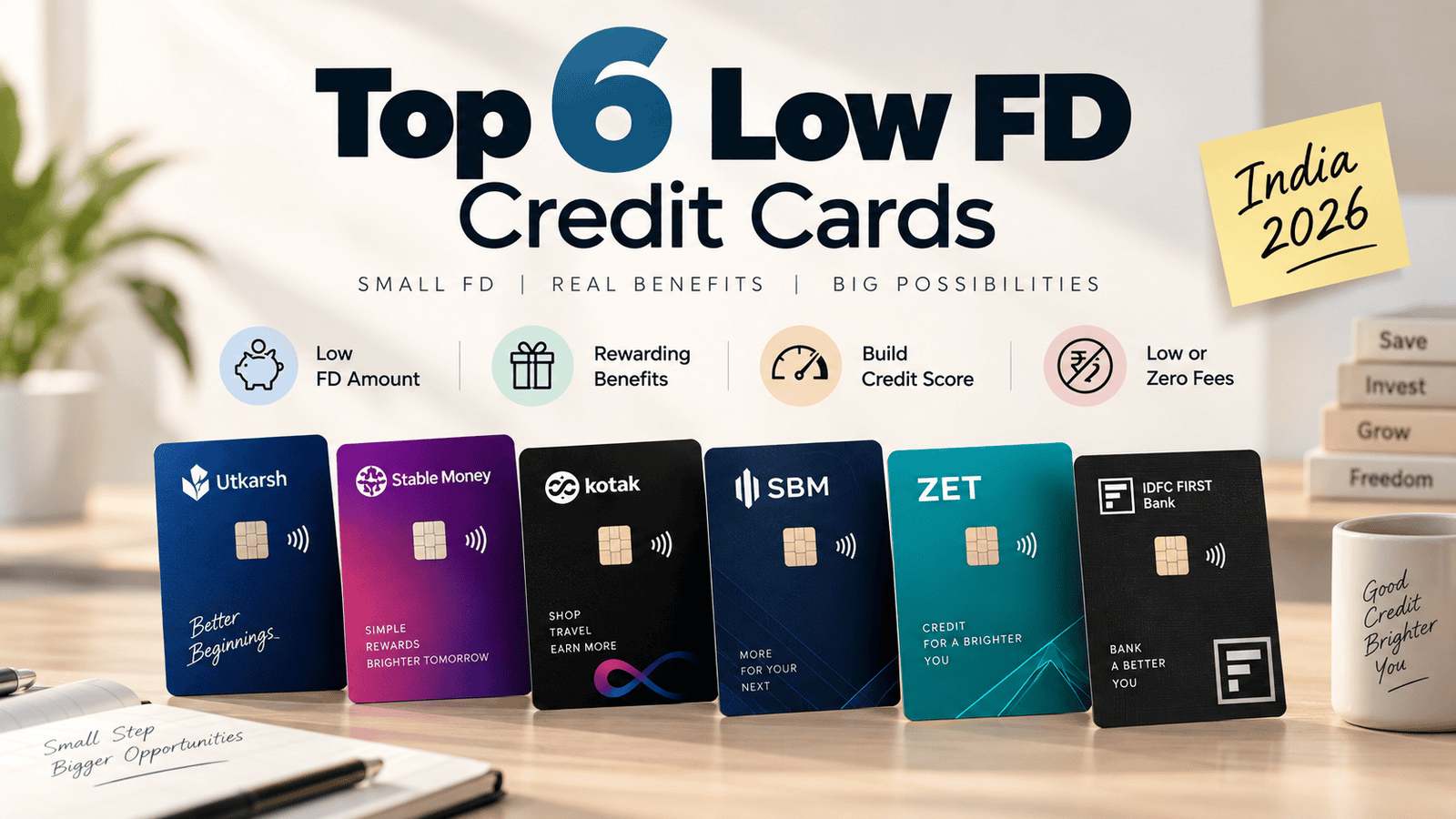
In this guide, we compare six low-FD credit cards available in India and explain what each card is best suited for.
Quick Comparison: Low-FD Credit Cards in India
| Credit Card | Minimum FD | Annual Fee | Key Benefit |
| Utkarsh SuperCard | ₹100 | Nil | Low entry point + cashback |
| Stable Money Suryoday RuPay Card | ₹1,000 | Nil | Cashback + lounge access |
| Kotak811 Super Money Card | ₹1,000 | Nil | Shopping + UPI cashback |
| SBM Paisabazaar Paisa+ | ₹2,000 | ₹499 + taxes | Cashback on online spends |
| SBM ZET Credit Card | ₹2,000 | Nil | UPI + lifestyle offers |
| IDFC FIRST EA₹N | ₹5,000 | ₹499 + taxes | Up to 100% FD-linked limit + cashback |
Fees, cashback rates, eligibility and other benefits can change. Always check the latest issuer terms before applying.
What Is an FD-Backed Credit Card?
An FD-backed credit card, also called a secured credit card, is issued against a Fixed Deposit.
For example, suppose you create a ₹10,000 FD. The bank holds that FD as security and provides a credit card with a limit linked to the deposit.
The exact credit limit depends on the card. Some cards may offer around 90% of the FD as the credit limit, while others can offer up to 100%.
The important point is that the FD does not automatically pay your credit card bill.
You still have to use the card normally and pay your credit card bill on time. The FD primarily acts as security for the card.
These cards can be particularly useful for people who are new to credit or have limited credit history.
1. Utkarsh SuperCard
The Utkarsh SuperCard stands out because of its extremely low entry requirement.
The current minimum deposit mentioned by Utkarsh Bank is just ₹100 for an FD linked to the SuperCard. The card also has no joining fee and no annual fee.
The card offers cashback on eligible transactions. Utkarsh’s current information mentions 1% cashback on eligible UPI and non-UPI credit card transactions, along with additional cashback offers on selected merchants such as Myntra and Flipkart.
One important point is that a ₹100 FD does not mean you will automatically receive a ₹10,000 or ₹20,000 credit limit. The credit limit is determined separately under the bank’s applicable terms.
Why consider the Utkarsh SuperCard?
- Minimum FD starting at ₹100
- No joining fee
- No annual fee
- Cashback on eligible transactions
- UPI support
- Very low entry requirement
The main advantage here is simple: you can start your secured-credit journey with a very small deposit.
2. Stable Money Suryoday RuPay Credit Card
The Stable Money Suryoday RuPay Credit Card starts with a minimum FD of ₹1,000 and is positioned as a lifetime-free secured credit card.
The card offers cashback on spends and supports RuPay-based UPI payments. Current Stable Money information also highlights airport lounge access as one of its key benefits.
The lounge benefit is where things get more interesting.
According to the current card benefit document, eligible physical cardholders can get domestic lounge access twice per quarter and international lounge access twice per year, subject to the applicable conditions. A ₹2 charge applies to domestic lounge visits.
There is an important catch, though.
The physical card and lounge access have eligibility conditions. The current terms state that the physical co-branded card starts above a ₹36,000 card limit. Therefore, you should not assume that simply creating a ₹1,000 FD will immediately give you lounge access.
Why consider this card?
- ₹1,000 minimum FD
- Lifetime-free
- RuPay card
- Cashback on spends
- Airport lounge benefits subject to eligibility
- Useful for users who want both credit-building and travel-related benefits
3. Kotak811 Super Money Credit Card
The Kotak811 Super Money Credit Card also starts with a ₹1,000 FD and has no annual fee.
Its biggest attraction is cashback, particularly for online shopping and UPI transactions.
Current listed benefits include:
- 5% cashback on eligible Myntra spends
- 3% cashback on eligible Cleartrip spends
- 2% cashback on eligible Flipkart spends
- 1% cashback on eligible UPI spends
These benefits are subject to applicable minimum-spend requirements and cashback limits.
The card is issued on the RuPay network, which makes it suitable for eligible UPI transactions through supported apps.
For someone who regularly shops on Myntra or Flipkart and also uses UPI, the cashback benefits can make this card more useful than a basic secured card that only focuses on credit-building.
Why consider the Kotak811 Super Money Card?
- ₹1,000 minimum FD
- No annual fee
- RuPay card
- Cashback on UPI
- Higher cashback on selected shopping platforms
- Useful for online shoppers
4. SBM Paisabazaar Paisa+ Credit Card
The SBM Paisabazaar Paisa+ Credit Card requires a minimum FD of ₹2,000.
Unlike a completely free card, it has an annual fee of ₹499 plus applicable taxes, although fee-waiver conditions may apply based on spending.
Its biggest attraction is cashback.
For FD amounts between ₹2,000 and ₹10,000, eligible online transactions earn 1% cashback. If the FD amount is above ₹10,000, the online cashback rate can increase to 1.5%.
Eligible offline spends earn 1% cashback, while UPI cashback is available when the applicable total UPI spending condition is met.
The card therefore makes more sense for people who actually use their credit card regularly.
If your spending is very low, the annual fee can reduce the value of the cashback you earn.
Why consider Paisabazaar Paisa+?
- ₹2,000 minimum FD
- Up to 1.5% cashback on eligible online spends
- 1% cashback on eligible offline spends
- UPI cashback subject to the applicable spending condition
- Credit limit linked to the FD
- Useful for regular online spenders
The key thing to remember is that the annual fee needs to be considered alongside your expected cashback.
5. SBM ZET Credit Card
The SBM ZET Credit Card also starts with a ₹2,000 FD and comes with no annual fee.
Instead of focusing purely on traditional cashback, ZET combines UPI rewards with discounts and offers across lifestyle and shopping categories.
The card currently offers discounts on platforms such as Swiggy, Zomato, Instamart and BookMyShow, along with 5% cashback on Amazon and Flipkart vouchers and additional cashback on selected partner brands.
The card also offers 2% cashback on ZET UPI payments, but this particular benefit requires an active ZET Plus subscription, currently priced at ₹3 per day.
That subscription condition is important because the 2% UPI cashback should not be treated as a completely free, unconditional benefit.
Why consider the SBM ZET Card?
- ₹2,000 minimum FD
- Lifetime-free card
- RuPay/UPI functionality
- 2% ZET UPI cashback with ZET Plus
- Cashback on selected vouchers
- Lifestyle discounts and partner offers
This card is more relevant for users who can actually use ZET’s ecosystem of offers.
6. IDFC FIRST EA₹N Credit Card
The IDFC FIRST EA₹N Credit Card comes with a higher minimum FD requirement of ₹5,000.
The major advantage is that the credit limit can go up to 100% of the FD value, subject to the applicable terms.
The card is designed around UPI and cashback. According to IDFC FIRST Bank’s current cashback terms, eligible UPI transactions through the IDFC FIRST Bank mobile app earn 1% cashback. UPI transactions through other supported apps earn 0.5%, while eligible online spends also earn 0.5%. Cashback is capped at ₹500 per statement cycle.
The card has a ₹499 joining fee and a ₹499 annual fee from the second year onwards, plus applicable taxes.
So this is not the lowest-entry card on the list.
However, the combination of a potentially 100%-of-FD credit limit, RuPay functionality and cashback makes it worth considering for someone comfortable with a ₹5,000 FD.
Why consider IDFC FIRST EA₹N?
- ₹5,000 minimum FD
- Credit limit up to 100% of FD
- RuPay card
- UPI support
- 1% cashback on eligible UPI spends through the IDFC FIRST Bank app
- 0.5% cashback on other eligible UPI and online spends
- ₹500 cashback cap per statement cycle
Which Low-FD Credit Card Should You Consider?
There is no single card that will suit every user. The right choice depends on how much you want to deposit and how you plan to use the card.
If your priority is the lowest possible FD
The Utkarsh SuperCard has the lowest starting deposit in this comparison, with a ₹100 minimum FD currently mentioned by Utkarsh Bank.
If you want lounge access with a low FD
The Stable Money Suryoday RuPay Credit Card offers airport lounge benefits, but the relevant eligibility conditions should be checked before applying.
If you want shopping and UPI cashback
The Kotak811 Super Money Credit Card focuses heavily on cashback across selected shopping platforms and UPI.
If you want cashback on regular online spending
The SBM Paisabazaar Paisa+ can offer up to 1.5% cashback on eligible online spending, but its annual fee needs to be considered.
If you want a lifetime-free card with lifestyle offers
The SBM ZET Credit Card combines a ₹2,000 FD requirement with lifestyle discounts, voucher cashback and ZET UPI rewards.
If you want up to 100% of your FD as credit limit
The IDFC FIRST EA₹N can provide a credit limit of up to 100% of the FD, subject to applicable terms, but requires a higher ₹5,000 minimum FD.
Things to Check Before Getting an FD-Backed Credit Card
The minimum FD is only one part of the decision.
Before applying, check these points:
1. Credit Limit
Do not assume that every card gives 100% of the FD as your credit limit. Depending on the card, the limit may be around 90% or another percentage.
2. Annual Fee
A card with higher cashback is not necessarily better for someone who spends very little. Calculate whether the cashback you expect to earn justifies the annual fee.
3. Cashback Conditions
Cashback often comes with minimum transaction values, spending categories, monthly or statement-cycle caps, or other conditions.
4. UPI Eligibility
Not every credit card supports UPI. If UPI is important to you, check whether the card is issued on the RuPay network and which UPI transactions qualify for rewards.
5. Lounge Access Conditions
Lounge access may depend on the physical card, credit limit, spending requirements or other eligibility conditions. Do not look only at the headline number of lounge visits.
6. FD Closure
The FD acts as security for the card. You should understand the process for closing the card and releasing the FD after all outstanding dues have been cleared.
Final Thoughts
FD-backed credit cards can be a practical starting point for people who do not qualify easily for conventional credit cards.
The biggest advantage is that the FD reduces the issuer’s risk, which can make these cards accessible to people who are new to credit or have limited credit history.
At the same time, the card should not be selected purely because it has the lowest FD requirement.
A ₹100 or ₹1,000 FD may get you started, but the more important question is what you get in return: credit limit, cashback, UPI support, fees and other benefits.
For a very low entry point, Utkarsh SuperCard stands out. For lounge-related benefits, Stable Money Suryoday is worth examining. For shopping and UPI cashback, Kotak811 Super Money is a relevant option. Paisabazaar Paisa+ focuses on cashback, ZET combines UPI and lifestyle benefits, while IDFC FIRST EA₹N offers up to 100% FD-linked credit limit with cashback.
Always check the latest fees, eligibility criteria, cashback conditions and issuer terms before applying, because credit card features can change over time.
Frequently Asked Questions
Can I get a credit card with a ₹1,000 FD?
Yes. Some FD-backed credit cards in India currently start at ₹1,000, including the Stable Money Suryoday RuPay Card and Kotak811 Super Money Credit Card.
Can I get a credit card with a ₹2,000 FD?
Yes. SBM Paisabazaar Paisa+ and SBM ZET currently have minimum FD requirements of ₹2,000.
Does an FD-backed credit card help build credit history?
Yes. When the card issuer reports your repayment behaviour to credit bureaus, responsible usage and timely payments can help establish a credit history. However, building a good credit profile depends on your overall repayment behaviour and credit utilisation.
Is the FD used to pay my credit card bill?
No. The FD primarily acts as security for the credit card. You still need to pay your credit card bills normally.
Can I get a credit card without an existing credit score?
FD-backed cards are specifically designed to reduce dependence on an existing credit history. However, approval and eligibility are still subject to the issuer’s applicable terms.
Which FD-backed card has the lowest minimum FD in this list?
The Utkarsh SuperCard currently has the lowest stated minimum deposit at ₹100.
Should I choose a card only because it has the lowest FD?
No. The FD amount is only one factor. You should also compare the credit limit, annual fee, cashback, UPI support, spending conditions and benefits that you will actually use.

I write about credit cards, personal finance, banking products, and money-saving tips for CardZen. My aim is to make financial topics easier to understand and help readers make informed decisions.